I, like so many others, first heard the name Raj Rajaratnam on October 16, 2009 when he was indicted at a high-profile FBI press conference on insider trading charges. Specifically, Rajaratnam stood accused of trading on non-public information related to six companies between 2003 and 2009, through his hedge fund, Galleon group, and eliciting gains of approximately $63 million.
At the time, I’d been working at a hedge fund administrator for over three years, so it was natural to take a professional interest in the case. But personally, I was vested too by virtue of our shared nationality - we were both Sri Lankan. By November 2010, the FBI’s investigation of hedge funds, dubbed “Operation Perfect Hedge” hit closer to home. Three of our own hedge fund clients were indicted — two of whom were my direct clients: Level Global Investors and Diamondback Asset Management; the third was S.A.C. Capital.
The hedge fund industry was already reeling from the likes of the 2008 credit crisis, the resulting recession, the Bernie Madoff investment Ponzi scheme, and the collapse of many firms whose bets did not survive the market downturn. As I worked on the liquidation of Level Global and Diamondback, Rajaratnam soon became a forgotten memory.
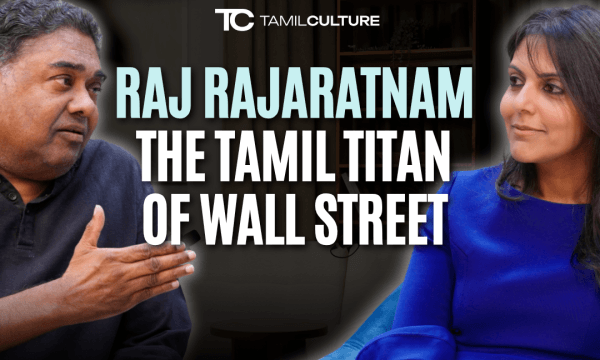
Until recently that is, when I found myself invited to interview Rajaratnam for TamilCulture (TC). I didn’t know what to expect. After sixteen years working with New York hedge fund clients, I’d learned that most personalities in the industry were either assholes or eccentrically charming assholes. Rajaratnam had also spent 7.5 years in prison. And prison can do strange things to people. So it was a gamble, but one I decided was worth the take.
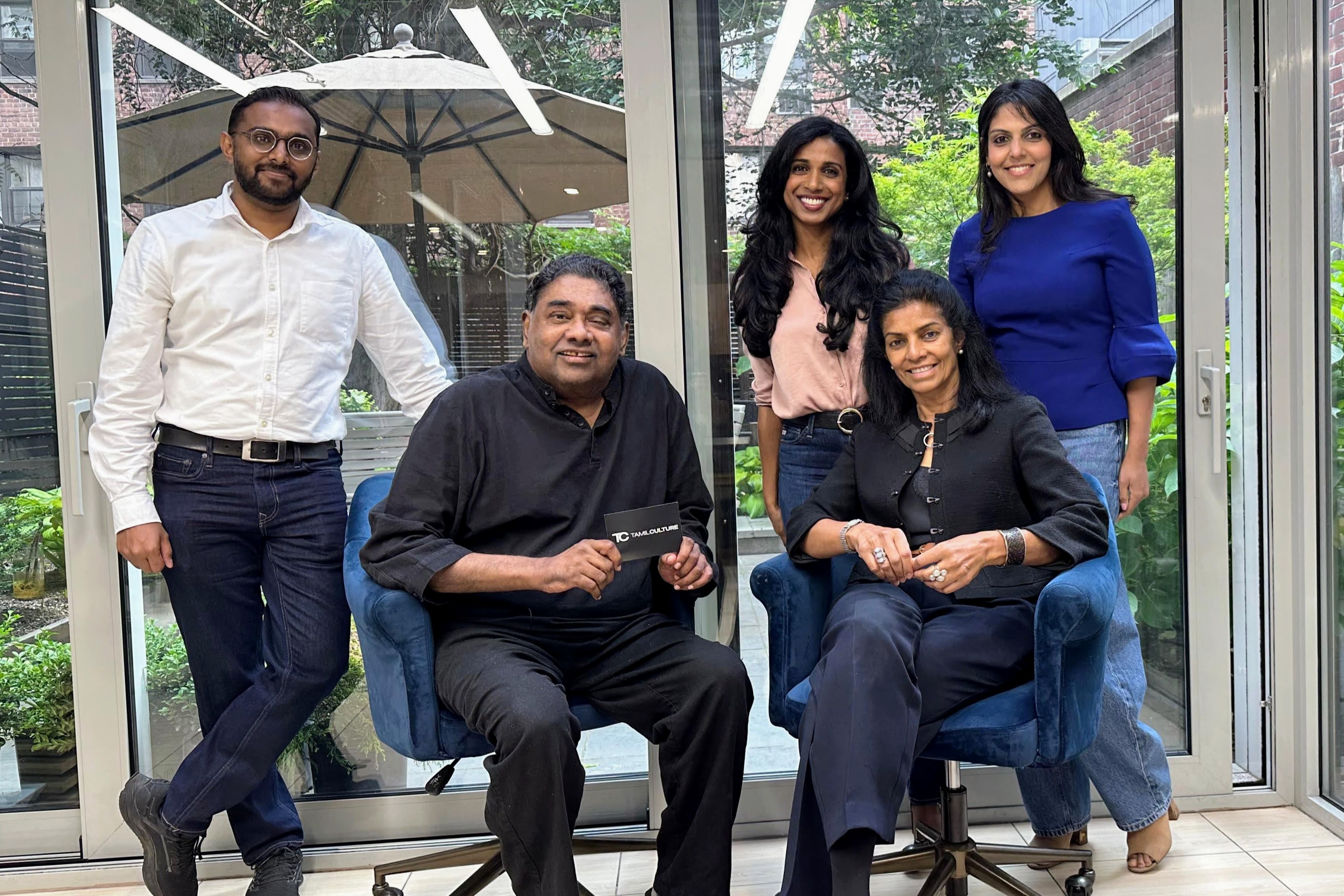
And so, on a sunny Friday afternoon in June, I headed to Rajaratnam’s midtown Manhattan office with the team from TC.
I still haven’t watched the recording of my conversation with Raj; I can call him Raj now, having met him. Like most people, I cringe at seeing myself on camera. I’m a writer at heart, and there’s so much that the camera couldn’t quite capture, that is worth documenting. So I choose to also write about my encounter with Raj Rajaratnam. To not do so would be a missed opportunity for me, for the man himself, and for the over-35 Tamil audience who, as we discovered post-shoot, followed Raj’s story with a heady mix of admiration, curiosity, and confusion.
Raj wrote a book called Uneven Justice to tell his side of the story: the charges, the trial, life behind bars. Give it a read. In the meantime, here’s my perspective on an afternoon spent with Raj.
Raj Rajaratnam, whose name literally means “king of gems”, lived up to the promise of his name, becoming one of the most successful hedge fund managers of his time. In 2008, at the height of his career, Raj was worth $1.8 billion and ranked 262nd on the Forbes 400 richest Americans list. His entrepreneurial venture called Galleon Group, launched in 1997, managed over $7 billion in assets and employed almost 180 staff. It became one of the largest and most coveted tech-focused hedge funds by marquee investors.
Galleon’s New York office first opened on 400 Park Avenue before moving to the 34th floor of 590 Madison Avenue — both prime Manhattan real estate near Central Park and Grand Central Terminal, and located in a corridor lined with financial heavyweights like Blackstone, Avenue Capital and Davidson Kempner. At the time, Galleon was also running offices in London and Singapore, with ambitions to launch an Emerging Markets fund across South Asia and Southern Africa.
In New York hedge fund culture, office space isn’t just real estate; it’s theater. Firms project luxury through sleek interiors, curated art, cutting-edge technology, and layers of support staff all intended to impress clients and lure top talent. Galleon’s offices fit the part: open-concept, bright, and tastefully designed with just enough polish to reassure marquee investors that they were betting on a firm at the top of its game.
Raj’s personal life also reflected the hallmarks of New York’s financial elite. A $17.5 million apartment on Manhattan’s Upper East Side (plus a neighboring one for his parents), a $5 million estate in Greenwich, Connecticut: these were standard markers of success among peers of his wealth and stature. But 2007, the year he turned fifty, marked a different kind of milestone. That year, Raj flew seventy friends and family to Kenya for a luxury safari, chartered a boat around Manhattan for another celebration, and, in a moment of pure flourish, spent $4 million to have Kenny Rogers perform at a Western-themed clambake. If his homes reflected the conventions of wealth, his fiftieth was about leaving an impression. Suffice to say that Raj lived it up. And honestly, why not, when you’ve got that kind of money?
So imagine my surprise when we showed up at a quiet side street off Third Avenue, rang the bell on an unmarked black door, and entered what was apparently Raj’s new office. Inside, we found a modest, sunlit space: six glass desks with computer monitors, a small kitchen, a bathroom, and a private nook for Raj. There were glass doors opening to a serene back garden and a few personal touches — a nod to Jaffna, his heritage, his history. It was functional, unpretentious. A far cry from Park Avenue.
But it was Raj himself who surprised me more than the space. In preparation for our meeting, I’d watched many hours of interviews with Raj post his release from prison. I knew he’d shaved off his signature mustache and lost some of the weight that once gave him plump cheeks and a broad, imposing presence. Still, the man who greeted me was strikingly different from the images most etched in my memory, those of him striding out of the courthouse during his trial. Today, Raj is nearly seventy. Time and a fractured hip from a recent fall have slowed his step. Yet what might first appear as frailty quickly gives way to something else: a deliberate pace, a measured voice, a man who commands attention not by force, but by presence.
Raj was having lunch when we walked in. Seafood pasta was on the menu. He didn’t let lunch get in the way however, as he greeted us warmly and offered to order food. “Thai, Italian, Indian, whatever you want,” he said. Later, when we were setting up, he asked if we’d like coffee and ordered cappuccinos for the crew. Ridiculous as this may sound, it was Love Cake that broke the ice. Turns out Raj has a sweet tooth and snacks on a small slice of Sri Lankan Love Cake — a rich, spiced semolina confection — most days after lunch. He offered us each a piece. And since I bake, naturally we turned to food and my dreams of opening a bakery one day. We quickly fell into conversation.
That first connection opened the floodgates. Raj began asking questions about our backgrounds. At one point, he burst out laughing, genuinely amused by the crew he was sitting with. See Raj has stopped doing interviews. These days he’s in his “JOMO” phase — the joy of missing out — living a quiet life, focused on investing and giving back, inspired by Raj’s father who had taught him that life followed three phases: learning, earning, and giving back.
Raj only agreed to this interview because he thought we were adolescents working on a school project. He’d nearly backed out after realizing TamilCulture’s reach. But upon meeting us, a mishmash of religions, cultures and personal and professional profiles, our youthful aura disarmed him. Or maybe he just didn’t take us seriously. Either way, we ran with it.
Before the camera even started rolling, our conversation had pinballed across unexpected topics. No question was off limits, he said. And since this is far more fun than talking about corporate kills or career successes, let’s address the obvious: Raj’s past is colorful. He’s likely partied harder than most of you reading this. But as they say, what happens in Vegas stays there. So let’s just say this: Raj wasn’t just a hard-nosed Wall Street Titan. He knew how to live on the edge.
In what might be his biggest gamble ever though, on Wall Street’s worst day in 2008, as markets were crumbling, Raj decided to take a nap. His traders had come into his office that morning seeking advice on what to do. Raj listened to his panicked team, asked for some time to think, crawled under his desk, and took a nap. He emerged thirty minutes later, rested, and instructed his traders to buy. The market rebounded by day’s end and Galleon made a pretty penny. That evening, Raj bought out a whole bar to celebrate with his team. Meanwhile, at home, his parents had prepared his favorite comfort food, iddiyappam, fearing he’d been wiped out. He never made it to dinner.
If there’s a thread that runs through Raj’s life, it’s this: comfort never kept him still. Even as the son of a corporate executive, a young analyst at Chase Manhattan, a board member at Needham & Co., Raj had a restlessness, a thirst for more, better, and to carve his own path. He traces it back to boarding school in India, starting at age eleven, where he learned to fight, think for himself, and question rules. He wasn’t built for rigid systems. He wanted to be his own boss. That moment came in January 1997, just shy of 40, when he launched Galleon Group.
On his path to fundraising for Galleon, Raj landed at the doors of George Soros. If you don’t know the name, look him up. He’s a big deal. Soros offered $200 million in seed funding, but at a steep discount: a 1% management fee and 10% performance fee. The norm was 2 and 20. Raj declined. Using a mango seller analogy (as only a South Asian might), he told Soros that undercutting the market would ruin the ecosystem for everyone, forcing sellers to slash prices or exit. Supply would shrink, prices would rise, and they’d end up right back where they started.
The conversation stalled and soon the meeting with Soros ended. Raj wasn’t willing to undercut his competitors and friends; he’d look elsewhere for the money. But just like in the movies, as Raj was leaving the Soros Fund Management offices, Soros' assistant called out for Raj. And the rest as they say is history because Soros blinked, bought over by the logic and equity of Raj’s argument. And so began the reign of the Galleon Group.
______________________
If Raj was such a principled and fair-minded person, one might ask: how did he end up convicted of a financial crime and sentenced to 11 years in prison?
Raj was charged with the crime of insider trading: the act of buying or selling securities based on material non-public information, giving the trader an unfair advantage over the broader market.
One example of such a trade involved Galleon’s purchase of Goldman Sachs shares on September 23, 2008. That day, during a board call, it was announced that Warren Buffett would invest $5 billion in the firm: a significant vote of confidence amid the financial crisis that would surely have a positive impact on Goldman's share price. Just 23 seconds after the call ended, Rajat Gupta, a Goldman board member, called Raj. Between 3:54 p.m. and the market’s 4 p.m. close, Galleon bought Goldman shares. The next morning, news of Buffett’s investment went public. Goldman’s stock surged, and Galleon walked away with an estimated $900,000 profit.
There were several other trades cited by prosecutors, some more obviously suspicious than others. Raj has vigorously defended himself, claiming he was unaware that any of the information he received was non-public, and that all trades were supported by extensive research, industry analysis, and publicly available data. In the finance world, it is a widely accepted practice for finance professionals to speak with corporate insiders, who often do so to attract investment in their companies. Raj contends that such conversations may include both public and non-public insights, which hedge funds then analyze to form their own investment thesis — an approach commonly referred to as “mosaic theory.” He has also argued the prosecution was selective — focusing on 0.02% of his firm’s trades — motivated by ambition, enabled by invasive wiretaps, and built on pressure tactics used against colleagues and even his family.
It’s worth noting: wiretaps were first used against the mafia. When the FBI launched “Operation Perfect Hedge,” it treated insider trading with a similar level of severity.
______________________
When TamilCulture approached Raj for an interview, our goal wasn’t to re-litigate a case that had already been put to rest. It was to give the Tamil community, especially the younger generation, a chance to better understand the man behind the headlines. But naturally, after our meeting and the research that preceded it, people have asked what I really thought about Raj’s case. Was he innocent? Or was he guilty?
First, I must say, I liked Raj. A lot. He was warm, genuinely welcoming when many in his position (he’s practically a billionaire) might have chosen to keep us at arms length, and full of spice and wit. Just my type of person. While his health might not be its best, do not for a moment underestimate this man. “Only the paranoid survive,” he told us. It’s a motto that feels apt for both Wall Street and especially now that he’s spent time in jail with the likes of Mafia bosses. Even during our conversation, his eyes kept flicking to the stock ticker on TV. Raj was still in the game.
He also doesn’t give a damn what anyone thinks, so he didn’t hesitate to share his opinions — or put us on the spot to challenge ours: America has lost its way. A lack of hard work and effort is what holds most people back. Wall Street is still the center of the financial industry, even as the digital economy tries to redraw the map. How could I, as a Muslim, believe in God when Gaza was burning? When am I starting my bakery? America will find its way again.
Jaffna will also find its way, he said, and Raj is determined to play a part in that journey. He has a soft spot for the region, having built a home there where he spends his winters. Through an entity he founded called Synamon Global (an offshoot of his family office), Raj is channeling growth capital into Jaffna’s agriculture, fishing, and manufacturing sectors. His aim is simple but ambitious: to help local businesses and the district itself retain more of their value chains. “People will always need to eat,” he says, and he’s right. But Raj is also looking beyond the basics. Through Yarl IT Hub, a grassroots tech incubator in Jaffna, he supports entrepreneurs working to build a more advanced, innovation-driven ecosystem for the region.
And that brings us to Raj’s second mantra: “Only idiots die rich.” I don’t know if a millionaire in Raj’s life stage will die “poor”; realistically he’ll probably leave behind plenty, with a will that takes care of his kids and a few charities. But the point is, he isn’t hoarding. He’s putting money into causes he believes in, without hunting for tax loopholes or applause.
To my surprise, Raj admitted that the same capitalist machinery that propelled him upward has failed most people. Now, he sounds closer to a progressive Democrat than a Wall Street titan: open to higher taxes on corporations and the wealthy, and vocal about expanding social protections in healthcare, education, and employment. Coming from Raj, it felt less like ideology and more like a seasoned insider acknowledging the cracks in the system. And now, he’s backing initiatives that aim to address those cracks, putting his money where his beliefs lie.
So the Raj of 2025 is opinionated, charismatic, socially conscious, and living a life that’s decidedly low-key. But what about the Raj of 2009 — the high-flying, relentless, and extravagantly audacious hedge fund titan? Was he innocent or guilty of insider trading?
I’m not a lawyer. I haven’t pored over every piece of evidence so my opinion is inconsequential. However, if the jury believed Raj was guilty of insider trading, it’s important to remember that he wasn’t a lone soldier.
When I mentioned the interview to three investment banker friends, they all rolled their eyes. “Insider trading is everywhere," they said.
Out of curiosity, I asked our mutual and relatable friends — Google’s Gemini AI and ChatGPT — what hedge funds mean when they talk about their “edge.” Their answer: “Having better, faster, or more insightful information than the rest of the market.” And they do. Hedge funds have plenty of tools at their disposal to sift through public information in real time: dedicated research teams, cutting-edge tech, and rigorous compliance frameworks that monitor how information is sourced and used.
But in a high-stakes industry where access is everything, business talk happens constantly: on golf courses, over dinners, at strip clubs, even on boats in the Bahamas (just ask Martha Stewart). Every day, someone makes an investment decision based on something they heard in passing, something they maybe shouldn’t have. And more often than not, no one bats an eye.
Raj has long argued that U.S. insider trading laws are vague, inconsistently applied, and selectively enforced. And he’s not wrong. In fact, there is no specific statute in the U.S. that directly defines or prohibits insider trading. Instead, the government relies on broader anti-fraud provisions, originally intended to combat deception in the markets, to also regulate insider trading activity.
Jonathan Streeter, the Assistant U.S. Attorney and lead prosecutor in Raj’s case admitted in 2012: “Insider trading cases are confusing to investment professionals… the lines are a bit murky.” Then, in 2020, a task force composed of law school faculty and former US lawmakers, led by Preet Bharara — the U.S. Attorney who oversaw the broader crackdown on insider trading via Operation Perfect Hedge — called on Congress to pass a clear, codified insider trading statute. The group pointed to conflicting decisions across judicial circuits that have created widespread confusion about what actually constitutes the crime.
So while most agree that trading on non-public information to gain an unfair advantage is wrong, the lack of legal clarity, and inconsistent enforcement, means the investment industry still operates in a legal gray zone.
Raj has also argued that the jury did not have enough financial literacy to understand hedge fund trading strategies, the amount of research they undertake, the compliance frameworks under which they operate, and their use of expert consultants.
And here’s the truth: multiple truths can exist at once.
Unfortunately for Raj, it was he and not the jury, the NY Prosecutor’s office or vague trading laws that was on trial on May 11, 2011, when the jury handed down their guilty verdict. Raj was sentenced to 11 years in prison and fined over $150 million.
In the end, it wasn’t the ambiguity of the law that mattered, but the clarity of the verdict. A clarity that marked a staggering fall for a man once at the pinnacle of Wall Street.
_____________________________
Shortly after interviewing Raj, I shared a photo of us with a friend. They asked how I could pose with a criminal.
“Pretty easily,” I said. “You stand next to them, smile, and say cheese.”
We often engage, willingly, with people who’ve committed serious moral wrongs: those who’ve cheated parents and family members, abused their partners, abandoned their children, exploited workers, harmed animals, swindled people in business, or hurt others physically or emotionally. Many of these actions never make headlines. There are no mugshots, no courtrooms, no jail time. Just silence.
And yet, we give these injustices a pass because it’s convenient. Because the wrongdoers are close to us. Because they benefit us. Because their actions don’t challenge the comfort of our cultural, religious or social narratives. I’m not here to excuse wrongdoing. But I do believe we could all benefit from being a little less self-righteous, and a lot more self-reflective.
So yes, I’m fine with my picture with Raj Rajaratnam. He’s had a controversial past, one he’s paid for, confronted publicly, and continues to reckon with. Today, he’s trying to live a quieter, more purposeful life. Maybe it’s redemption. Maybe it’s just growth.
The real issue isn’t whether someone like Raj deserves a second chance. It’s how willing we are to reserve our harshest judgment for those whose wrongdoings are publicly exposed, while quietly excusing others whose actions remain hidden, familiar, or convenient. That’s the discomfort we don’t talk about. Not justice — but selective morality. And maybe, the real discomfort isn’t the photo I took, but the reflection it forces.
Another reaction I often get, equally strong, if less self-righteous, is: “Why didn’t he just plead guilty?”
Twenty-six people were indicted in the Galleon insider trading case. All but two — Raj and Danielle Chiesi — took plea deals. Raj chose to fight the charges and go to trial. When I shared those numbers and that Raj was sentenced to prison, the response I often get is, “well that was a stupid thing to do.”
Statistically speaking, they have a point. According to the American Bar Association, 98% of criminal cases in the US are resolved with a plea bargain. This outcome is a by-product of the need for efficiency versus a reflection of a fair and just system. So only about 2% of cases go to trial and the conviction rate there is a whopping 97%. Further, the penalty or sentence on the back of a trial is double that of a plea bargain. The odds clearly were stacked against Raj. So yes, going to trial was neither the smart nor safe option.
But Raj believed in his innocence. And he believed he would get a fair trial. I’m not qualified to weigh in on whether he did. But I imagine Raj also believed, given his confidence, his track record, his resources and his legal team, that he could win. He’d made bold bets his entire life. This was the biggest one yet.
If Raj lost, he wouldn’t just lose his money or reputation. He’d lose everything: the work that defined him, and the family he loved. But he chose to fight. We often take the easier path. Raj chose the hard one. Maybe it was pride. Maybe it was principle. Maybe it was both. But there’s something to be said for not taking the easy way out.
Raj missed out on many milestones during his time in prison. His children grew up and graduated college. His father, his role model, passed away. But Raj has no regrets about going to trial. In the final page of his book, he narrates a visit from his family in the fall of 2017, where his oldest daughter, then a law student told him:
“Dad, I’m so glad you didn’t plead guilty. I’m so glad you fought because
you didn’t do anything wrong. Even though we would have
had you home sooner if you’d plead guilty.”
The respect and belief of his loved ones gave Raj a sense of justice no court ever could. His story reminds us that sometimes, the hardest battles are fought not for public approval, but for personal truth.
_________________________
As we wrapped up our conversation, I asked Raj about the legacy he wants to leave behind.
“I am not a legacy guy," he said. He just wanted to be remembered as someone who didn’t back down. Someone who, when punched, got back up and kept going.
Raj has definitely been punched — hard. His bubble of invincibility burst, his name dragged through the headlines, his freedom stripped away. But he’s not unique in being tested. Life humbles all of us, eventually, in the places we hold most dear. Raj’s fall just happened to be more public because his rise had been more spectacular.
Still, his answer surprised me. Raj, even now, radiates the confidence of a man who believes anything is possible: undeterred, unshaken in his beliefs, unapologetic about his past. So I’d expected a bolder answer, some sweeping vision of redemption. But as we settled in the garden to film b-roll, away from the larger crew, the conversation shifted.
Raj asked about my life: my family, my work, what I hoped to build. He offered stories of his own, and with them, unguarded glimpses into his fears.
All the money in the world hasn’t made Raj immune to the quiet, persistent worries that follow so many parents. He thinks constantly about his children: the uncertain job market they face, the broken planet they will inherit, the relationships and families they’ll build, and the world he’ll leave behind.
In trying to give them a better future, he’s found himself returning to his own roots: back to Sri Lanka, to Jaffna, where his story began.
There’s something telling about that: that after a career defined by ambition and global reach, Raj’s next chapter is rooted in something quieter, more enduring. His legacy may not be carved into headlines or hedge fund returns, but into communities, into continuity, into home.
And that might have been the quietest, most powerful realization of all.
We came into the interview expecting a story of scandal and excess, and instead found something more difficult to define; and more familiar. A man who has lost, endured, recalibrated, and kept going.
So if there’s anything to know about Raj Rajaratnam today, it might be this: He’s no longer the man Wall Street once feared or envied. That life doesn’t even inspire him anymore. Instead, he’s a father, a husband, a son; just a man trying to get it right with the time he has left. He’s investing in something more lasting: a return to his roots, and a legacy shaped not by power, but by purpose.
Interviews like this one rarely go to plan and are almost always unnerving. You brace for discomfort, for tension, for things to go sideways. When it ends, you’re usually relieved it didn’t, or disappointed it did. But when we said goodbye and watched Raj drive off in a black sedan, none of us felt relief or disappointment. Instead, it felt like we’d just spent the afternoon with an old friend: sharp, funny, willing to be challenged, and just as willing to challenge in return.
That wasn’t the story we expected. But it’s the one worth telling.